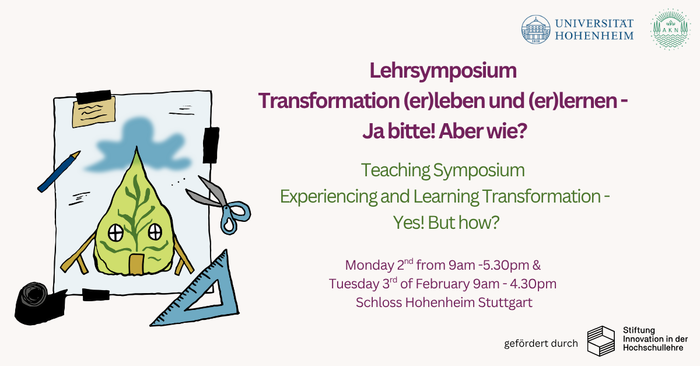
The Symposium Programme
DAY 1 - MONDAY, 2. FEBRUARY
09:00 | Registration and reception |
09:45 | Welcome and introductions |
10:00 | Keynote 1: Dr. Katja Brundiers, University of Freiburg Transformational Sustainability Education – A Review of Programs This talk reviews selected transformational sustainability education programs worldwide and examines how well they align with the goal of equipping students with competencies to co-develop scalable solutions to complex sustainability challenges. Using a set of criteria covering learning objectives, pedagogy, assessment, learning environments, and institutional support, the review identifies common shortcomings and highlights good practices from programs that successfully address them. |
10:50 | TREE in practice – Insights from two years of transformative learning at the University of Hohenheim In this session, the TREE project team (Anna Struth, Amelie Schönhaar, Jun-Prof. Dr. Verena Seufert) shares key insights, outcomes, and student experiences from two years of experimenting with transformative teaching and learning at the University of Hohenheim. |
11:15 | “Interactive” coffee break with Gallery Walk Students from TREE modules present their work |
11:45 | Parallel workshops I: Doing transformation – Creative practices for change ------------------------------------ Birgit Hoinle and Amelie Schönhaar, University of Hohenheim - Räume bilden und aneignen – kollektives Kartieren als partizipative Methode für sozial-ökologische Hochschultransformation (in German) (Balkon Saal) Für welche Zukunft lernen wir eigentlich und vor allem, wie? Was bedeutet buen vivir? Laut Greenpeace Nachhaltigkeitsbarometer 2025 fühlen sich nur 9% der befragten Studierenden sehr gut auf die Bewältigung von Zukunftsherausforderungen vorbereitet. BNE, Globales und transformatives Lernen haben einen ganzheitlichen Anspruch: sie zielen auf ein Lernen mit Kopf, Hand und Herz ab. Wie können wir Hochschulen als sozial-ökologische Möglichkeitsräume erschließen? Mittels kollektiv-kritischem Kartieren erkunden wir gemeinsam Orte des buen vivir, machen Macht- und Nutzungsstrukturen sichtbar und entwickeln Visionen für klimagerechte, transformative Lehr-Lernumgebungen. ------------------------------------ Julia Herzog, University of Applied Arts, Vienna - Arts of Change: fostering social sustainability through creative methods (Aula) Departing from the sample project "Arts of Change", a mentoring programme initiated in 2020 to collectively explore the role of the arts and music within fostering sustainability and transformation, this session sheds light onto creative methods for active change-making in educational settings. This is an interactive workshop; participants are guided through a set of activities on the topic of joint spaces and social sustainability. ------------------------------------ Saskia Regorius and Anna Struth, University of Hohenheim – Collaging the University (Blauer Saal) This workshop – co-run by a TREE student and a TREE project member - explores the use of collage as a creative and reflective method in teaching to re-imagine the university. Through hands-on collage-making, participants will experiment with visual thinking to question existing structures, surface tacit assumptions, and envision alternative futures for higher education. The workshop invites educators to experience collage as a low-threshold, playful, and powerful tool for fostering imagination, critical reflection, and dialogue in the classroom. |
13:00 | Lunch break (Hohenheim Palace) |
14:00 | Keynote 2: Prof. Dr. Mandy Singer-Brodowski, University of Regensburg Creating safe enough and brave spaces when dealing with resistance against sustainability transformations Societal resistance is becoming increasingly apparent in ongoing sustainabilityrelated transformation processes. This also poses challenges for university education as a place for empowering change agents who will accompany these socio-ecological transformation processes in the future. The lecture focuses on emotions in transformative learning processes in the context of sustainability and how to create safe enough and brave spaces for dealing with phenomena of resistance. |
14:50 | Interactive discussion: Keynotes, taken further… An interactive session focused on collective reflection and discussion on the topics of the keynotes. We invite participants to deepen their shared insights and connect them to their own experiences. |
15:45 | Coffee break (Hohenheim Palace) |
16:15 | Campus Exploration: Good Practice Projects and Initiatives from and around Hohenheim A guided campus walk showcasing good practice projects and initiatives from and around Hohenheim, highlighting how the campus functions as a space for both formal and informal learning. |
17:30 | End-of-day & Conference Dinner: Soup disco (Schnippeldisco) Location: Gemeindezentrum Padua, Wollgrasweg 11, 70599 Stuttgart End the day with a communal cooking experience that brings reflection, music, and food together. In the Soup Disco, participants jointly chop vegetables, cook, and reflect using guided prompts while enjoying music in an informal atmosphere. The session is co-created with the student group FRESH, part of Slow Food Youth, and invites connection, care, and shared nourishment. |
DAY 2 - TUESDAY, 3. FEBRUARY
08:30 | Arrival and coffee |
09:15 | Keynote 3: Prof. Dr. Markus Riederer and Sandra Sattlecker, University of Würzburg The presentation outlines a university-wide approach to embedding Higher Education for Sustainable Development (HESD) across all disciplines, which earned the University of Würzburg the National Prize for Education for Sustainable Development in May 2025. Launched in 2022 with the Teaching4Sustainability experiment, the initiative connects stakeholders across the institution and is anchored in target agreements that balance shared principles with faculty autonomy. Professional development, a digital programme on Interdisciplinary Sustainability Sciences, and cross-status networking support the systemic integration of sustainability in teaching and curricula. |
10:15 | Parallel workshops II: Facilitating Transformative Learning ------------------------------------ Gundula Büker und Johanna Menzinger, Entwicklungspädagogisches Informationszentrum Reutlingen (EPiZ): Facilitating Transformation (in German) (Blauer Saal) Lernprozesse im Sinne einer „Bildung für eine sozial-ökologische Transformation“ zu gestalten, erfordert umdenken: Welcher Anspruch ist damit verbunden? Was bedeutet dies für die Rolle der „Lehrenden“? Welche Kompetenzen brauchen sie? Welche didaktischen Kriterien kommen bei der Gestaltung von transformativ ausgerichteten Lehr-Lern-Prozessen zum Tragen? In diesem Workshop werden wir uns diesen Fragen annähern, Beispiele von Bildungsangeboten für Studierende und Multiplikator*innen vorstellen und Möglichkeiten der Kompetenzentwicklung aufzeigen. ------------------------------------ Vanessa Weihgold, University of Tübingen: Climate Emotion in the classroom (Aula) Traditional education in Europe focuses on the transmission of information. However, topics such as war or climate change do not only appeal to students’ rational thinking, but also to their emotional perception of the world. Unfortunately, teachers and lecturers are often not sufficiently prepared to deal with these emotions. Therefore, we will not only engage with some theoretical background on climate emotions, but also work with a pedagogical methodology that addresses emotional experiences. |
11:25 | Coffee break |
11:45 | Parallel workshops II - continued |
12:15 | Lunch break (Mensa) |
13:30 | Panel discussion & Fishbowl: Quo vadis ESD @Uni Hohenheim and beyond? In a panel discussion followed by a fishbowl format, we explore the question “Quo vadis ESD (Education for/as sustainable development)?” Where are you going? at the University of Hohenheim and beyond. The session invites open exchange on current developments, future perspectives, and possibilities for shaping ESD, with active participation from the audience. Jun- Prof. Dr. Laura Henn (University of Hohenheim, Sustainable Behaviour and Management) Prof. Dr. Sebastian Hess (University of Hohenheim, Vice President for Academic Affairs) Prof. Dr. Markus Riederer (University of Würzburg, WueLAB Sustainability Lab) Member AKN (Student Group Sustainability, University of Hohenheim) TBD |
15:00 | Joint conclusion of the teaching symposium |
15:30 | Shared coffee and networking time |